

Athena Blog • Hair Restoration
Hair Transplant Results Timeline: What to Expect Month by Month
A hair transplant is not an overnight change. It is a gradual transformation that unfolds over about a year. Here is exactly what happens at each stage, so you can enjoy the journey with confidence instead of worry.
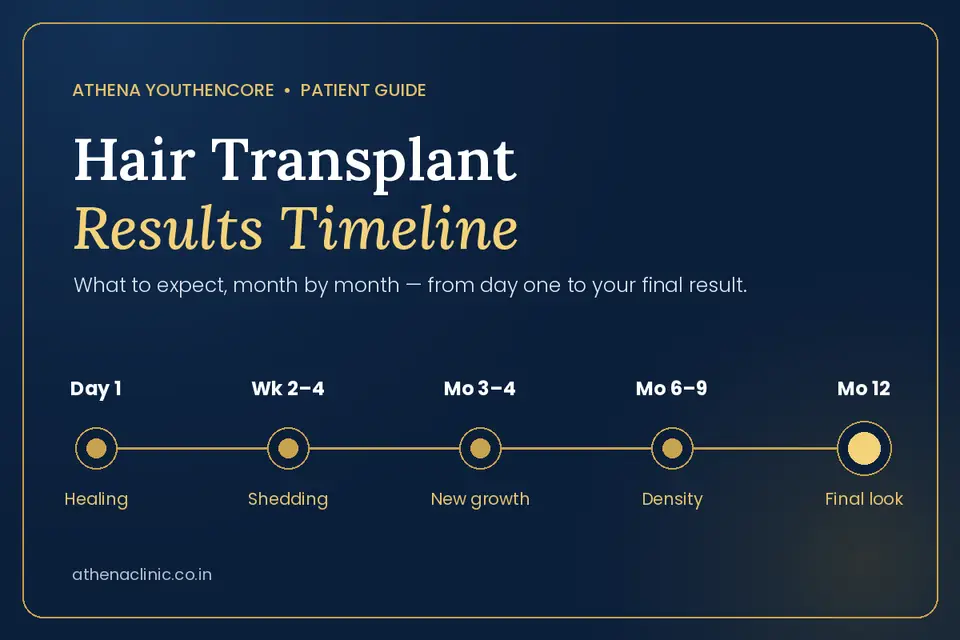
At Athena Youthencore Hair & Skin Studio, one question comes up in almost every follow-up visit: “Is this normal?” Whether it is the shedding at week three or the quiet scalp at month two, nearly everything you notice after your procedure is part of a very predictable process. Understanding that process is the best way to stay calm, follow your aftercare well and protect your final result.
The Timeline at a Glance
| Stage | Timing | What you will notice |
|---|---|---|
| Healing | Days 1–10 | Tiny scabs, mild tenderness and some swelling that settles within days |
| Shedding | Weeks 2–4 | Most transplanted hair shafts fall out while the follicles stay in place |
| Quiet phase | Months 2–3 | Follicles rest; the scalp looks much like it did before surgery |
| First growth | Months 3–4 | Fine, soft new hairs begin to appear, often unevenly |
| Density builds | Months 4–6 | More hairs emerge and gradually thicken |
| Visible change | Months 6–9 | Clear improvement in coverage that others begin to notice |
| Final result | Months 9–12+ | Hair matures and blends naturally; the crown may improve until 15–18 months |
Why Results Take Time: Your Hair Growth Cycle
Transplanted follicles do not grow on a faster schedule just because they have been moved. They follow the same natural growth cycle as the rest of your hair, and that cycle is what shapes your timeline.
The minor trauma of being moved pushes most grafts into the resting phase. That is why they shed after a few weeks, pause, and then begin a fresh growth cycle around month three.
Your Month-by-Month Journey
Healing & Protection
Your grafts are settling in.
You may feel mild tightness or tenderness, and some patients notice swelling around the forehead for two to four days. Small scabs form around each graft and usually fall away by day 10.
The Shedding Phase
The stage that worries patients most, and the most normal.
Most of the transplanted hair shafts fall out. It can feel like the procedure has not worked, but the follicles remain safely rooted under the skin. Some patients also notice temporary shedding of nearby native hair, which regrows as well.
The Quiet Phase
Rest before regrowth.
Your scalp may look very similar to how it did before surgery. Beneath the surface, follicles are preparing to grow. Patience matters most here.
First New Growth
The first signs of your new hair.
Fine, soft and sometimes lighter hairs start to appear. Growth is often patchy at first, with some areas ahead of others. This unevenness is completely expected.
Density Builds
Your new hairline starts to take shape.
More follicles join in and earlier hairs begin to thicken and lengthen. Your hairline starts to look defined, although the result is still developing.
Visible Transformation
The change becomes obvious.
Coverage and density improve noticeably, and friends and family begin to notice. Hair texture continues to mature and you will have more freedom to style it.
Your Final Result
Mature, natural and entirely your own.
Most of the growth is in place and the transplanted hair blends naturally with your existing hair. The crown often continues to improve until 15–18 months, as it is usually the last area to fill in.
Tracking Your Progress the Right Way
Early photos can be confusing, and comparing yourself with someone else’s final result rarely helps. The most reliable way to see your progress is to compare your own photos over time:
- Take photos once a month, in the same room, with the same lighting.
- Capture the front, top, crown and both temples from the same angles each time.
- Keep your hair dry and styled the same way for every photo.
- Bring your photos to your follow-up visits so we can review them with you.
What Can Influence Your Timeline
Every patient follows the same broad stages, but the speed and fullness of your result can vary with:
How Athena Supports You Through Every Stage
- A doctor-led consultation with scalp and donor assessment before anything is planned
- A hairline designed around your face, age and natural hair direction
- High-density hair restoration planning, so every graft counts
- Clear written aftercare instructions and medications before you leave
- Scheduled follow-up reviews to track your growth stage by stage
- A direct line to our team on call and WhatsApp for any question along the way
When to Contact Us Straight Away
Most changes in the first weeks are normal. Please call us promptly, however, if you notice:
- Pain that is increasing rather than easing
- Spreading redness, warmth, pus or a bad smell
- Fever or feeling unwell
- Swelling that keeps getting worse after the first few days
If something simply does not feel right, reach out on +91 7567706000. There is no such thing as a silly question during your recovery.
The Bottom Line
A hair transplant rewards patience. The shedding, the quiet months and the patchy early growth are all signs that your follicles are doing exactly what they should. By around one year, most patients see a natural, lasting result that looks entirely their own.
Want a timeline personalised to your hair loss pattern? Our doctors can assess your scalp and walk you through what to expect. You can also read our day-by-day recovery guide or explore our hair transplant packages.
Frequently Asked Questions
When will I start seeing results after my hair transplant?
Most patients notice the first fine new hairs between months 3 and 4. Visible density usually builds from month 6, and the majority of the final result is in place by around month 12. The crown can take a little longer, often up to 15–18 months.
Is it normal for transplanted hair to fall out after a few weeks?
Yes. Between weeks 2 and 4, most transplanted hair shafts shed. This is called shock loss or shedding, and it is completely expected. The follicle stays safely rooted under the skin and begins producing new hair a few months later.
Why does my scalp look the same at month 2?
Months 2 to 3 are a natural resting phase. The follicles are preparing to regrow, so there is little to see on the surface. This “quiet phase” is normal and is not a sign that the grafts have failed.
Why is the crown slower to fill in than the hairline?
The crown has a whorl pattern and usually needs more grafts to look full, so the improvement there tends to appear later. It is common for the crown to keep improving until month 15–18.
Are hair transplant results permanent?
The follicles we transplant come from the back and sides of the scalp, which are naturally resistant to pattern hair loss, so they tend to last for life. Your existing, non-transplanted hair can still thin over time, which is why our doctors may suggest supportive treatment to protect it.
When should I contact Athena after my procedure?
Call us if you notice increasing pain, spreading redness, pus, fever, or swelling that worsens after the first few days. You are also always welcome to call or WhatsApp us on +91 7567706000 for any question about your progress, however small.
Begin Your Hair Restoration Journey
Book a doctor-led consultation at Athena Youthencore, CG Road, Ahmedabad, and get a treatment plan and timeline designed around you.
Book ConsultationWhatsApp UsCall +91 7567706000